Workflow11 min read
Can Hermes Agent Audit a Live Website? Testing VibeLeak MCP End to End
Connect Hermes Agent to VibeLeak MCP, audit a live website, inspect the security boundary, and export agent-ready remediation evidence.
Jul 22, 2026Read →

// BLOG_SIGNAL_FEED
ARTICLES_READYPublic notes
Launch notes, trust workflows, and practical explainers built to turn a scan result into the next fix.
Featured read
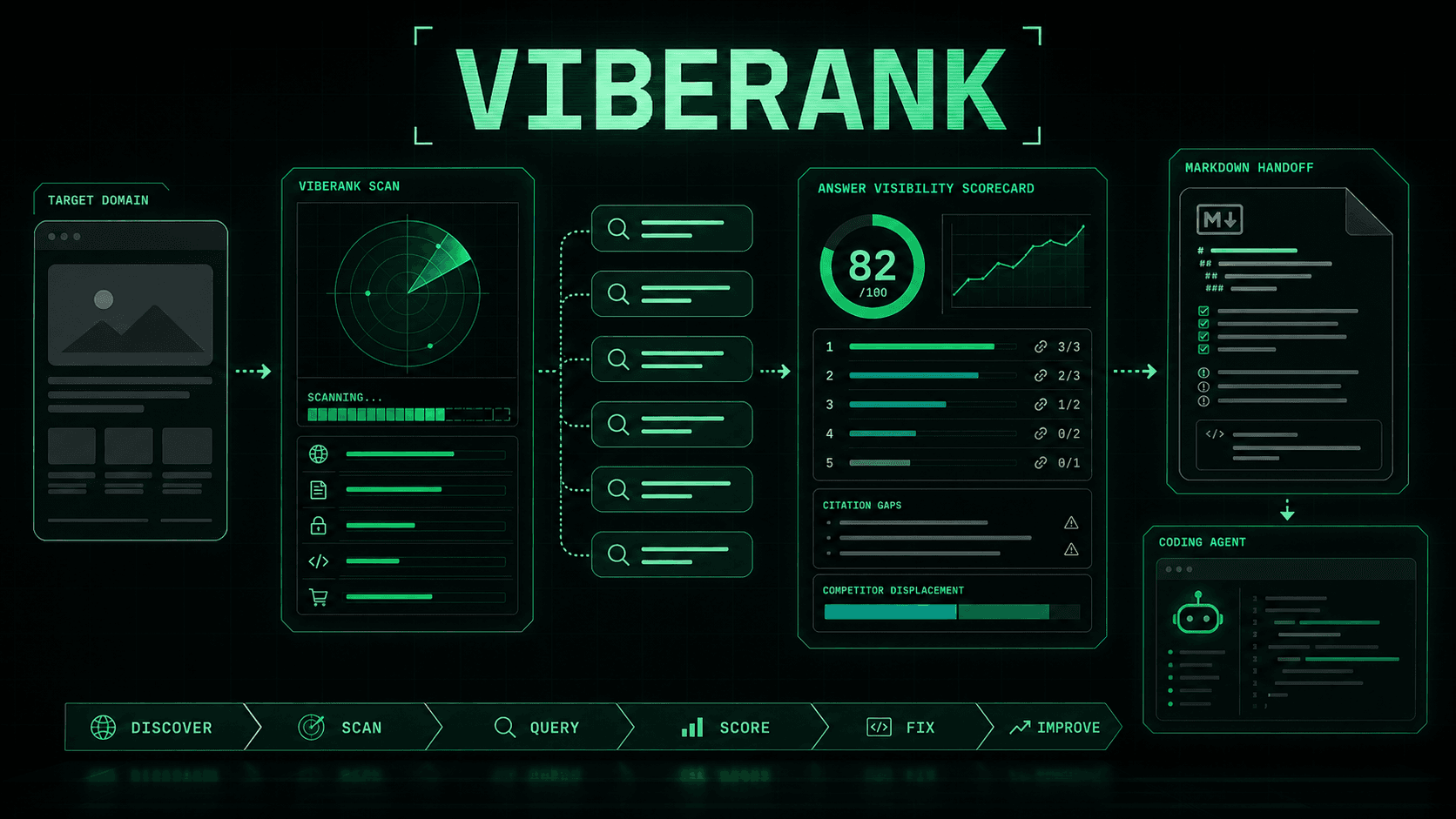
VibeRank builds a business profile first, generates prompts that fit the actual company, captures ranked search queues separately from AI answer citations, compares reruns over time, and turns the gaps into readable graded reports plus an agent-ready Markdown handoff.
Articles
Route-backed
Tracks
Launch, security, workflow
Mode
Scroll-aware reads
Article queue
25 queued
VibeRank is the paid VibeSignal extension that profiles the scanned business, grades answer visibility, tests matched AI-search prompts, captures ranked search queues, and exports Markdown plus PDF reports.
Connect Hermes Agent to VibeLeak MCP, audit a live website, inspect the security boundary, and export agent-ready remediation evidence.
Turn a VibeLeak public-surface scan into a structured security handoff for Codex Security and GPT-5.6 Sol to validate and patch.
Search is becoming conversational, agentic, and more selective about what it can understand. This is the practical checklist for making your public website easier for AI agents to find, read, use, and verify.
Impersonation scams are no longer just fake emails. They are polished websites, lookalike domains, copied badges, and AI-generated conversations. Your real website needs to make verification easier than the scam.
Before a customer buys from you, they run a mental checklist. Most of it happens in under 30 seconds. Here are the 10 signals that decide whether they stay — and how to verify each one.
Security seals can help, but a badge image is not proof by itself. Here is what common trust signals actually verify, what they leave out, and what real domain-bound proof looks like.
A real story about getting burned by a convincing supplier clone — and the exact five-minute verification checklist I built afterward so it never happens again.
The review threshold has crossed 20. 47% of consumers now say they will not use a business with fewer than 20 reviews, and 31% filter to 4.5+ stars only. Here is the honest playbook for getting there — and what to do if you are starting from zero.
AI tools can now replicate a business website in minutes. Not as a concept — as a working product. Here is what I found testing five of them, and what it means for every business with a public site.
The name reads aggressive on first contact. It is not a brand choice, it is a description of the problem. Here is what VibeLeak actually means, why "vibe" is short for vibe coding, and the rule that runs the product: catch the leak, before it leaks you.
OpenAI Daybreak signals a new era for AI cyber defense. Here is why founders, agencies, and builders should scan the public website surface before customers, crawlers, and AI agents judge it.
We scanned domains from the most popular website lists on the internet. The gaps are not exotic zero-days — they are headers, redirects, and missing surface controls that most teams skip.
A plain-English look at how VibeLeak scans public sites safely, what gets stored, who can see reports, and why full findings and Markdown exports stay owner-only.
VibeLeak ran its full trust surface scan against the Moz Top 500 most popular websites. This historical corpus still shows how common basic web security gaps are.
A VibeLeak scan returns a grade, a list of findings, and a percentile rank. Here is how to read each piece so you know what to fix first.
WAF blocks, DNS delays, timeouts, and redirect loops are the most common reasons a scan returns a failed grade. Here is what is happening and how to fix it.
Trust scores are not just for security teams. They affect conversions, SEO, partnerships, and investor due diligence. Here is how to make the business case.
.env files, .git folders, and config dumps are the low-hanging fruit attackers check first. Here is what to look for, why it matters, and how to clean it up.
A staging site went live with no HTTPS, missing headers, and an exposed .env file. Here is the exact timeline of how it went from Grade F to a cleaner Grade B in under two hours.
Security posture drifts over time. Score Watch runs scheduled rescans and emails you when a grade changes. Here is how to set it up and what to do when an alert fires.
VibeSignal is the AI-facing side of a public scan: discoverability, content access, bot access, protocol discovery, and commerce readiness — summarized as an AI Readiness Grade with a weighted secondary score.
Security scores are more useful when they are public. The Trust Index tracks Hall of Fame sites, biggest improvers, and live scans, and every scan shows your percentile rank.
There is a version of your site that hackers see before you ship. This checklist tells you what to validate in ten minutes so launch day is not when you find out.
Most sites ship with incomplete header coverage. This is the minimum viable set of security headers, what each one does, and how to fix what is missing.
Every site has a trust surface. Most teams do not look at it until something breaks. Here is what VibeLeak measures, why it exists, and what the score is actually for.