
GPT-5.6 Sol + Codex Security: Scan Outside, Fix Inside
VibeLeak finds public trust-surface signals from the attacker's view. Codex Security reasons inside the repository, validates vulnerabilities, and proposes reviewable patches. The agent-ready Markdown export connects the two.
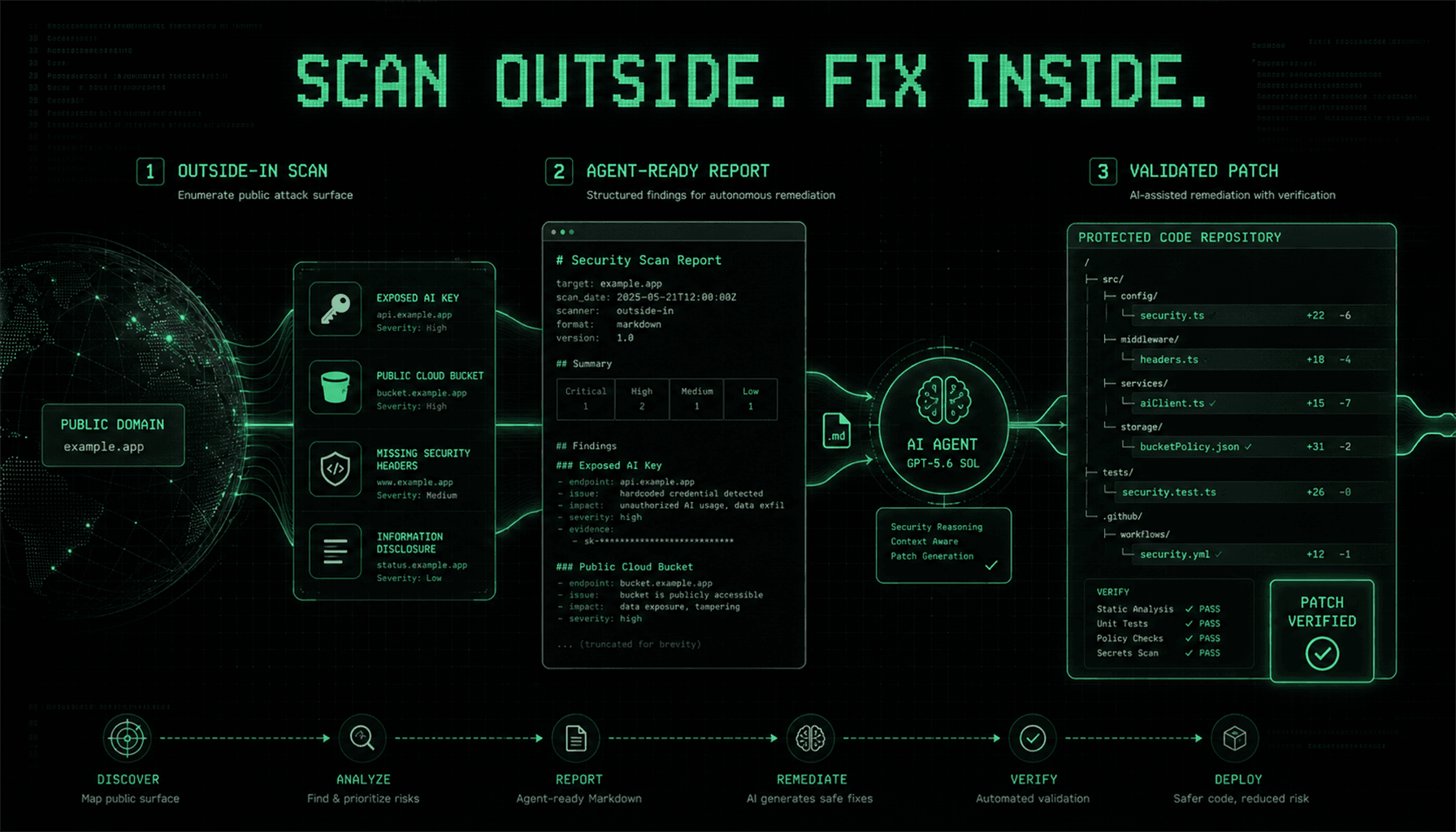
The trust loop
The security model got stronger. Your input signal still matters.
OpenAI's GPT-5.6 release gives defenders a much stronger reasoning engine. Codex Security gives that engine a repository-aware workflow. The practical question for builders is what evidence you hand it first.
The short version
If you ship websites or AI-built apps, this announcement matters because security work is moving closer to the code.
That is especially relevant for vibe coding security. Fast-moving teams can generate an impressive amount of product in a week, but the public deployment can still expose a missing Content Security Policy, a client-visible AI key, a cloud storage URL, or a route that behaves differently in production than it did locally.
GPT-5.6 Sol
What OpenAI actually announced
Two pieces matter here: a frontier model with stronger cyber performance and a security workflow designed to move from discovery to evidence to remediation.
The Last Ones
7 / 10
GPT-5.6 Sol completed the 32-step corporate-network simulation in seven of ten attempts.
GPT-5.5 baseline
2 / 10
The previous model completed the same long-horizon range in two of ten attempts.
Codex Security
3 stages
Identify the vulnerability, validate the finding, then propose a reviewable remediation.
Cyber benchmark movement
The headline result is real: in OpenAI's published system-card comparison, GPT-5.6 Sol completed The Last Onesin seven of ten attempts, up from GPT-5.5's two. OpenAI also reports major gains on ExploitBench and SEC-Bench Pro. But the most useful positioning is defensive: OpenAI says GPT-5.6 is better at finding and fixing vulnerabilities than at reliably carrying out autonomous end-to-end attacks against hardened targets.
Codex Security turns that reasoning into a workflow. It builds repository context and an editable threat model, investigates realistic attack paths, validates high-signal findings in an isolated environment where possible, and proposes a minimal patch. It does not silently rewrite production code. Humans review the evidence and decide what becomes a pull request.
Outside-in evidence
The missing piece is often the deployed public surface
A repository can look clean while the live domain still leaks useful clues. Deployment headers, edge configuration, generated bundles, cloud references, and public files only become fully visible after the app ships.
AIGuard
Looks for AI provider keys exposed in delivered HTML and conservatively checks bounded same-origin AI route signals.
CloudLeak
Finds public backend and cloud-storage references, including Firebase, Supabase, S3, Google Cloud Storage, and Azure Blob signals.
Security headers
Checks CSP, HSTS, frame protection, referrer policy, MIME sniffing protection, and the other controls browsers enforce on the live response.
VibeSignal
Measures whether crawlers and AI agents can discover, read, and correctly interpret the public site without inventing missing facts.
Keep the boundary honest
Operational workflow
Run VibeLeak, export the evidence, then let Codex validate it
VibeLeak's Markdown export is structured for AI coding agents such as Codex, Cursor, and Claude. It carries findings, severity, evidence, remediation guidance, verification steps, and a definition of done.
Scan the production URL
Run the live domain through VibeLeak. Review the trust grade, high-impact findings, AIGuard and CloudLeak signals, security headers, and VibeSignal posture.
Export agent-ready Markdown
Save the owned scan and download the structured report. This gives the coding agent concrete evidence instead of a vague request to “make the app secure.”
Open Codex Security
Attach or paste the report into the Codex Security plugin or workflow for the repository you own. Ask it to validate every finding against code and deployment configuration.
Review the patch
Inspect the attack path, validation evidence, proposed changes, and tests. Reject fixes that hide the symptom without correcting the root cause.
Deploy and rescan
Ship the reviewed patch, run VibeLeak again, and compare the public result. A fix is not finished until the live surface proves it.
Review the attached VibeLeak Markdown report for this repository.

For each finding:
1. Locate the responsible code or deployment configuration.
2. Validate whether the public evidence is reproducible and security-relevant.
3. Explain the attack path, assumptions, and false-positive risk.
4. Propose the smallest root-cause fix.
5. Add or update regression tests before changing behavior.
6. Run the relevant tests, lint, typecheck, and security validation.

Do not invent missing infrastructure. Keep unrelated behavior unchanged.
Return: validated findings, rejected findings, patch summary, verification evidence,
remaining risk, and the exact VibeLeak rescan checks needed after deployment.
Fast teams
Who gets the most value from this trust loop
The workflow is useful anywhere shipping speed has outrun security review, but it is especially strong for vibe-coded apps and small teams without a dedicated application-security engineer.
- Solo builders who used AI agents to assemble authentication, payments, storage, or API routes quickly.
- Agencies that need a repeatable pre-handoff check and a fix brief the delivery team can execute.
- Startups where infrastructure, frontend, and product decisions are landing in the same pull request.
- Teams migrating between cloud providers, AI APIs, or frameworks and worried about stale public configuration.
- Security reviewers who want an external signal to complement repository scanning and threat modeling.
The common failure mode is not that the team ignored security. It is that responsibility became fragmented. The website scanner saw the header. The developer knew the framework. The agent knew the code. Nobody carried one verified thread from the public symptom to the deployed fix. This workflow does.
Run it
Catch the leak before it leaks you
Start with the surface anyone can inspect, hand the result to a code-aware security agent, and prove the patch on the live domain.
One clean loop
FAQ
GPT-5.6 Sol, Codex Security, and VibeLeak
The scope boundaries worth keeping straight before you put an agent in the loop.
Does Codex Security replace a website security scanner?
No. Codex Security reasons from code and repository context. VibeLeak tests the live public surface. A deployment can expose signals that are not obvious from source alone, so use both views.
Does Codex Security automatically change my code?
No. OpenAI says it proposes patches for human review. Review the evidence, run your normal tests, and decide what becomes a pull request.
Can other coding agents use the export?
Yes. VibeLeak Markdown reports are agent-ready and can be used with Codex, Cursor, Claude, or another capable coding agent. Codex Security adds a purpose-built identify, validate, remediate workflow.
Sources
Source context: OpenAI's GPT-5.6 launch post, the GPT-5.6 system card, and the Codex Security documentation. VibeLeak is not affiliated with OpenAI or Codex Security.
Next action
Run the scanner against your own site
The article lands hardest when it turns into a fix list. Scan, close the gaps, and recheck.
Continue reading
More field notes
Workflow
AI agents are checking your website now. Here is the VibeSignal readiness checklist
Search is becoming conversational, agentic, and more selective about what it can understand. This is the practical checklist for making your public website easier for AI agents to find, read, use, and verify.
Open articleSecurity
Business impersonation is the trust problem your website has to help solve
Impersonation scams are no longer just fake emails. They are polished websites, lookalike domains, copied badges, and AI-generated conversations. Your real website needs to make verification easier than the scam.
Open articleLaunch Ops
The Small Business Trust Checklist: 10 Things Customers Check Before Buying
Before a customer buys from you, they run a mental checklist. Most of it happens in under 30 seconds. Here are the 10 signals that decide whether they stay — and how to verify each one.
Open article