
Why is it called VibeLeak? The vibe-coding leak problem and the catchphrase
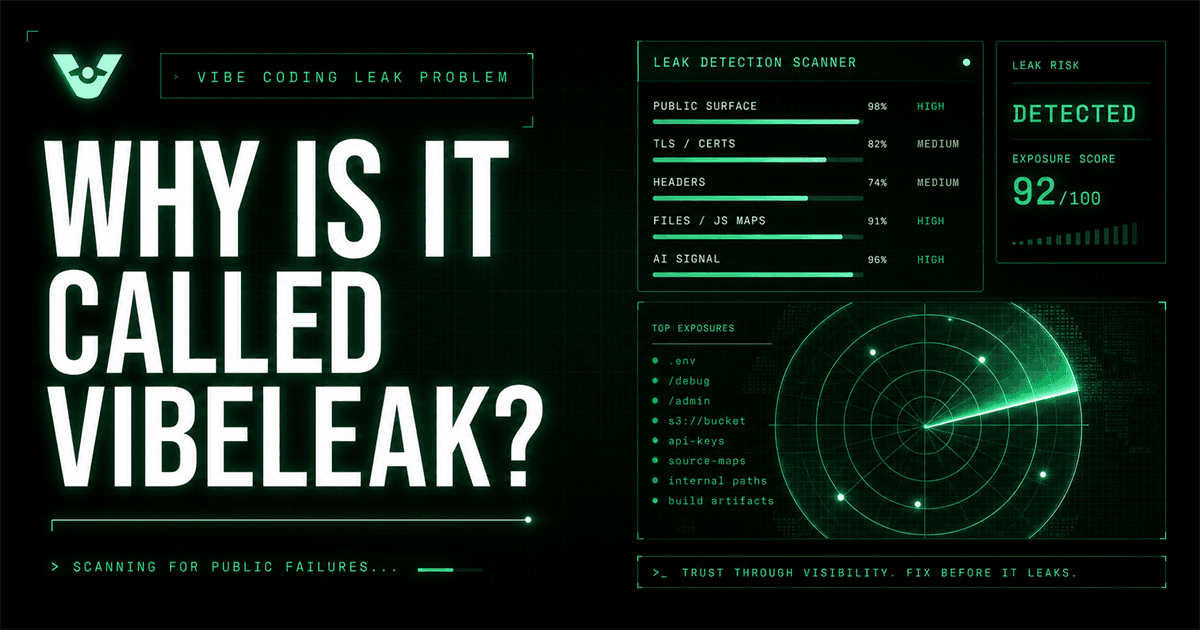
A short origin story for the VibeLeak name. "Vibe" is shorthand for vibe coding, the AI-assisted way modern sites ship fast. "Leak" is the silent public failure mode that ships with most of them. Together they name the problem the scanner is built to catch, and the catchphrase turns the name from a warning into a workflow.
Name origin
The name sounds like the problem because that is the point
A short origin note from Jon Komet, founder of VibeLeak.
I knew VibeLeak would read aggressive on first contact. I chose it anyway because the "vibe" is vibe coding, and the "leak" is what happens when fast AI-built sites go live with public defaults nobody checked. The softer names were VibeCheck and VibeCodeChecker; they did not say the problem cleanly enough. After watching the Tea app breach unfold, the rule became simple: Catch the leak, before it leaks you. The name is not a brand choice, it is a description of the problem.
Vibe
Vibe is short for vibe coding
This is not an aesthetic claim. It is a reference to the way modern sites are getting built, shipped, and exposed.
Vibe means vibe coding
- Public storage buckets left open after a fast build.
- Secrets and .env values shipped into the public bundle.
- Auth checked on the client, but not enforced on the server.
- Missing or misconfigured security headers.
- AI-facing metadata that makes the site invisible to crawlers and agents.
That is the new shape of the public web: more builders, faster launches, and more real products hitting the internet before anyone has made the security pass boring and repeatable. The point is not that vibe coding is reckless by default. The point is that a new building motion created a new responsibility gap, and the public web does not care whether that gap came from a human mistake, an AI suggestion, or a skipped checklist.
Leak
Leak is the right word for the failure mode
Most VibeLeak findings are not movie-scene exploits. They are public defaults that were never tightened.
Silent
No crash, no alert, no error. The site still loads, the checkout still works, and the owner may never notice.
Public
Anyone with a browser, a crawler, or an AI agent can inspect the same surface VibeLeak checks.
Default-driven
The issue is usually an owner's first miss, not an attacker first move: a setting left open, a header omitted, or a file shipped by accident.
The launch story said it in one line: "Trust on the front end, exposure underneath." That is the leak. The interface can look calm while the public surface quietly tells a different story.
Inversion
The catchphrase flips the name
The catchphrase flips the name from a warning into a workflow.
Catch the leak, before it leaks you.
Passive public scanning
The scanner runs against the public surface the same way a browser, crawler, or AI agent would. No target login is required.
The surface that should not surprise you
A leak is anything public that exposes data, weakens trust, or quietly costs SEO, AI visibility, and credibility.
Find it before a third party does
Most teams learn about their own leak when a customer, journalist, competitor, crawler, or agent finds it first. By then the cost is real.
That is the whole product, in nine words. It is also the bridge between security, launch readiness, VibeSignal, and the public credibility layer behind the Trust Index.
Operating rule
The rule that runs VibeLeak
Every scan is built around a practical ownership principle.
The rule
That rule is why the product cares about every scan, every recheck, every Markdown export, and the VibeLeak Score. The score is not decoration; it is the headline for how the score is built, what moved, and what still needs work.
Scanner
From a name to a scanner
The origin only matters if it turns into a useful fix loop.
VibeLeak scans the public surface of a website and grades it S-F on the things that decide whether a visitor, a search engine, or an AI agent trusts it. The grade is the headline. The private report, the Markdown fix list, and the recheck loop are the work. For the product version, read what VibeLeak scans. For the privacy boundary, read whether the scan is safe to run.
Transport
HTTPS + TLS
Secure route, redirect, and certificate posture.
Headers
Browser policy
CSP, HSTS, framing, nosniff, and related controls.
Exposure + AI
Public edge
Loose files, public defaults, and agent-facing signals.
Close
The whole story
The name is a warning, but the product is a workflow.
I wanted VibeLeak to be plain enough for a founder, designer, agency, or developer to understand before launch. It is not here to shame the builder. It is here to make the obvious checks happen while there is still time to fix them. Catch the leak, before it leaks you. That is the whole story.
Start scanNext action
Run the scanner against your own site
The article lands hardest when it turns into a fix list. Scan, close the gaps, and recheck.
Continue reading
More field notes
Workflow
Can Hermes Agent Audit a Live Website? Testing VibeLeak MCP End to End
Connect Hermes Agent to VibeLeak MCP, audit a live website, inspect the security boundary, and export agent-ready remediation evidence.
Open articleSecurity
GPT-5.6 Sol + Codex Security: Scan Outside, Fix Inside
Turn a VibeLeak public-surface scan into a structured security handoff for Codex Security and GPT-5.6 Sol to validate and patch.
Open articleWorkflow
AI agents are checking your website now. Here is the VibeSignal readiness checklist
Search is becoming conversational, agentic, and more selective about what it can understand. This is the practical checklist for making your public website easier for AI agents to find, read, use, and verify.
Open article